


Every vendor in the built world calls itself an AI company. Verantum's CEO refuses to.
In this Founder Series episode, Ryan Elazari sits down with Ryan Adelman, Chief Executive Officer of Verantum, to talk about why his company traded a 22-year-old brand name for one nobody had heard of, and what that rebrand signals about where building performance is headed.
Phoenix Energy Technologies spent 22 years becoming the name that large, multi-site portfolio operators trusted to manage HVAC, refrigeration, lighting, and energy across their buildings. Adelman joined the company six years ago and became CEO two years ago. Under his lead, the company expanded past comfort and energy optimization into full asset lifecycle management, tracking the health of the equipment itself rather than just its settings, culminating in this year's rebrand to Verantum, a name built from verus and quantum, truth quantified. Adelman explains why facilities and energy teams keep shrinking while the portfolios they manage keep growing, and why so much smart building technology gets installed, demoed well, and then dies the moment a technician has to use it in the field.
He makes the case against leading with AI, even though Verantum has used it for 15 years, and lays out how a conservative industry with zero tolerance for risk comes to trust one company enough to open its entire network, every controller and sensor, to outside integration. The conversation also covers Verantum's partnership with Leap, what deferred capital actually costs an owner over time, and the trait Adelman looks for after mentoring founders through Cleantech Open and Village Capital.
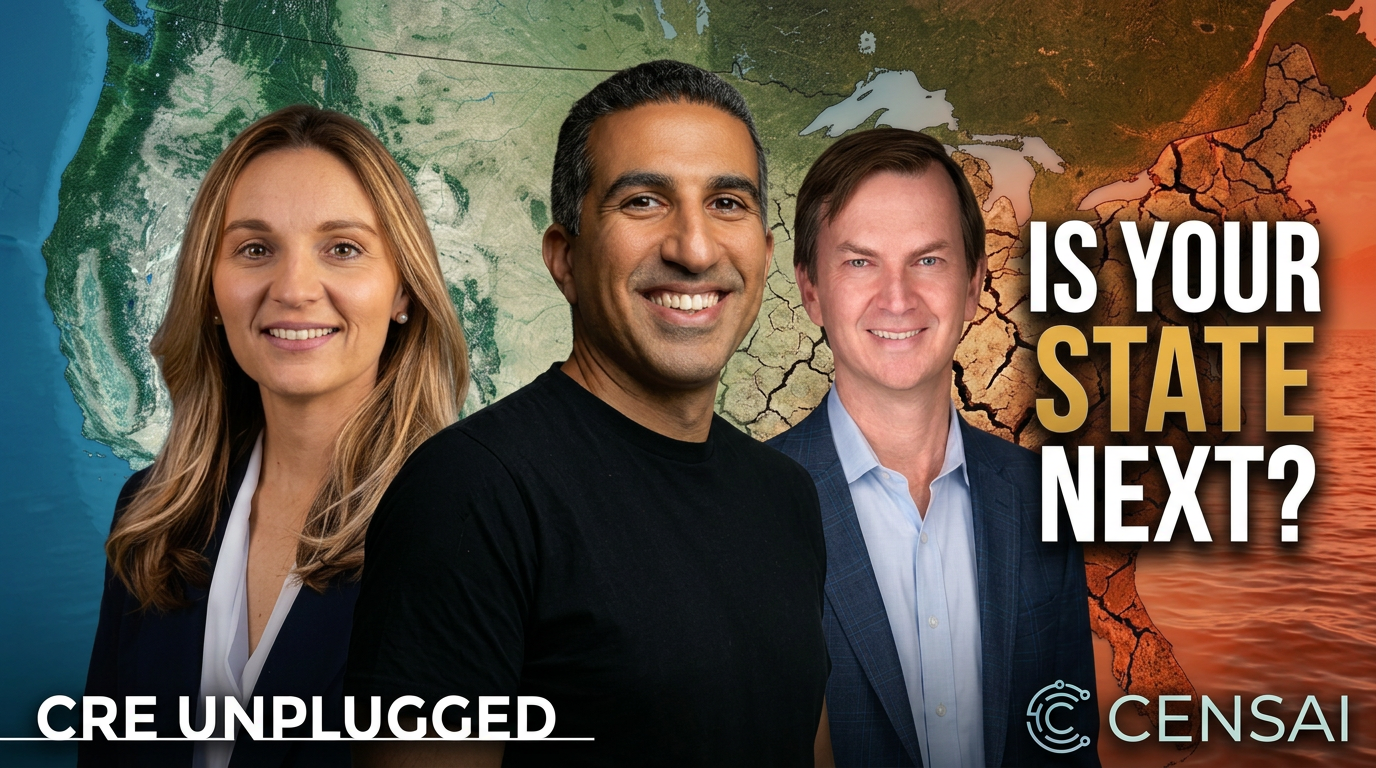
The data center industry is losing the public narrative, and CENSAI has the survey numbers to prove it.
In this Founder Series episode, Ryan Elazari sits down with Devin Boesen, Director of Population and Migration Products, and Jon Liggett, Head of Data and Partnerships at CENSAI, to dig into what population intelligence actually reveals about how Americans move, where they avoid, and why the stories being told about climate migration and data center opposition don't always match the data.
CENSAI was built during COVID, when census data was stale, U-Haul surveys were passing as market intelligence, and nobody could answer basic questions about where people were actually going, at the income level, the building level, or the zip code level. Devin and Jon explain how individual-level address history going back to 2009 became the foundation of a platform now used for multifamily diligence, student housing underwriting, and Snowbird market analysis across South Florida.
The conversation covers climate migration in detail: why the prediction of a great Midwest exodus isn't showing up in the data, what is actually happening along the Gulf Coast and in markets like Tampa and Orlando, and how insurance cycles interact with, but don't fully explain, where people move. They also address AI, specifically what has changed inside CENSAI in the last three months and why the real advantage isn't the chat layer everyone is bolting onto their products. And they share fresh survey data on data center sentiment: 44 percent of respondents oppose a data center near their home, a more negative reaction than they have to power plants, gas lines, battery storage facilities, or nuclear reactors.

Small businesses aren't credit risks. They're cash flow timing risks. And the commercial real estate industry has been treating them like the same problem for decades.
In this episode of the CRE Unplugged Founder Series, Ryan Elazari sits down with Alix Maurin and Joseph Thalinjan, Co-Founders of RentFlow, a Y Combinator-backed platform giving small business tenants flexible, cash flow-aligned rent payment solutions while ensuring landlords still get paid on the first of the month. Two former McKinsey consultants who discovered that nearly 50% of small businesses are late on rent, not because they can't pay, but because of a structural mismatch between when money comes in and when rent is due.
The conversation covers how RentFlow uses bank transaction data and AI to analyze actual payment behavior rather than outdated credit proxies, what landlords miss when they rely on traditional underwriting, and why the rigid monthly rent cycle built for 1950 is quietly damaging commercial portfolios today. Alix and Joseph also open up about product-market fit, navigating the transition from corporate to founder life, and what it really means to build through doubt.
Ryan closes with his Moneyball take: the landlords who adopt a data-driven approach to tenant relationships early will have the same competitive edge the Oakland A's had. This is that inflection point for commercial real estate.